
Why Are My Eyes Watering If I Have Dry Eye?
Posted in Dry Eyes, Eye Blog, Mount Vernon, Sedro-Woolley, Stanwood, Whidbey
August 2026
Quick Answer
It is a regular occurrence in my clinic: when I tell a patient they have dry eye, they respond, “Doctor, my eyes aren’t dry, they’re too wet!” I then explain that dry eye can cause a poor-quality tear film that doesn’t stay on the eye very well. When dry eye causes your tear film to break down like this, your tears run off the eye and down your cheek instead of coating it properly.
Tears Are More Complicated Than You Think
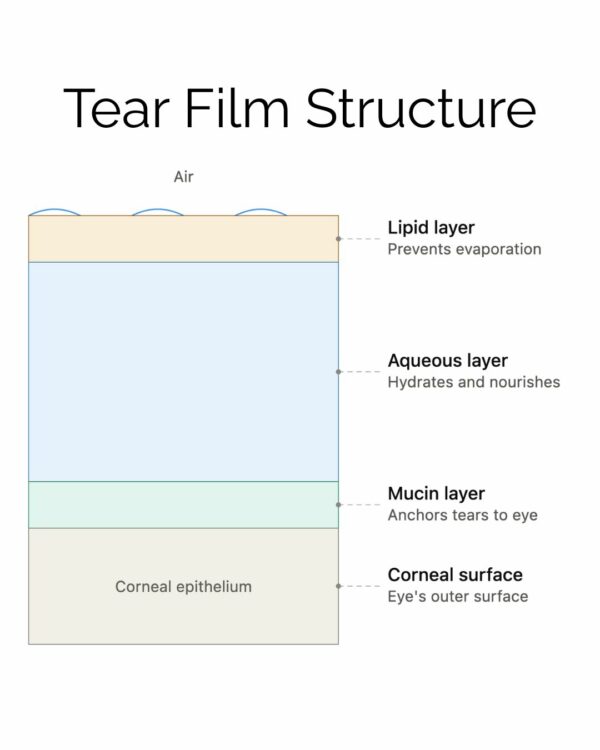
A common misconception I see in clinic is my patients picture tears as simple water that coats the front surface of their eye. In reality, a healthy tear film is made up of three distinct layers working together:
An oily (lipid) layer on the front of the tear film, produced by tiny glands along your eyelids called meibomian glands. This layer keeps your tears from evaporating too quickly.
A watery (aqueous) layer in the middle, produced by the lacrimal glands. This layer hydrates the eye and washes away debris.
A mucus (mucin) layer on the back side, which helps the tear film stick evenly to the surface of your eye.
For your tears to work properly, all three layers need to be present in the right amounts and working together. Dry eye happens when this system is disrupted — and that disruption can cause a wide variety of symptoms.
The Real Culprit: Reflex Tearing
Most cases of dry eye aren’t actually caused by not having enough tears. They’re caused by poor tear quality, often due to a lack of that oily outer layer. This is called evaporative dry eye.
When the oily layer is thin or missing — often because the meibomian glands are blocked or underperforming — your watery layer evaporates too fast. Your eyes become dry and send a signal to send more tears.
This is called reflex tearing, and the problem is that reflex tears are mostly water. They lack the oil and mucin needed to actually coat and protect your eye properly, so they wash across the surface and spill over the lid without fixing the underlying dryness. The result is a frustrating cycle: dry eye triggers watery eye, which does nothing to solve the dryness, so the watering continues.
Simply using more artificial tears doesn’t always solve the problem. In my clinic, I need to determine why your tears aren’t staying on the surface of your eyes in the first place.
Why This Matters for Treatment
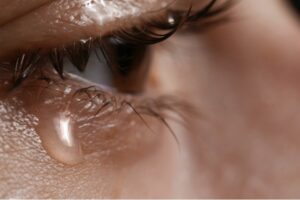
Here’s the key takeaway: if your eyes are watering because of dry eye, treating the “watery” symptom directly — for example, by avoiding fans or wind — won’t solve anything. The real issue is tear quality, not tear quantity. Effective treatment usually focuses on:
- Improving the oil layer, through warm compresses, lid hygiene, or in-office treatments for the meibomian glands.
- Reducing inflammation on the surface of the eye with prescription drops when appropriate.
- Stabilizing the tear film with preservative-free artificial tears designed to replace what’s missing, not just add more water.
- Addressing contributing factors like screen time, contact lens wear, certain medications, or environmental conditions.
Reaching for regular artificial tears can help temporarily, and I recommend them on a daily basis in my clinic. But if the underlying cause isn’t addressed, the watering-and-dryness cycle tends to come right back.
What I am Looking For In My Clinic
Depending on your symptoms, I evaluate your tear film, eyelids and meibomian glands, corneal surface, eye pressure, prescription, and the health of the structures inside your eyes. At Cascadia Eye Dry Eye Care Center, we have specialized technology (BOSA) that images your meibomian glands, along with giving me detailed information, like the thickness of that oily lipid layer.
I will also want to know when the watering happens. Is it worse outdoors? While driving? When you’re reading? After several hours on a computer? In the morning? In only one eye? These details can provide important clues.
When Watery Eyes May Mean Something Else
Watery eyes aren’t always caused by dry eye. Depending on your symptoms, other possibilities can include allergies, eyelid problems, blocked tear drainage, infection, inflammation, a foreign body, corneal problems, or changes in your vision.
Pay particular attention to whether the watering is happening in one eye or both, whether it is constant or intermittent, and whether you have other symptoms.
What Are My Treatment Options?
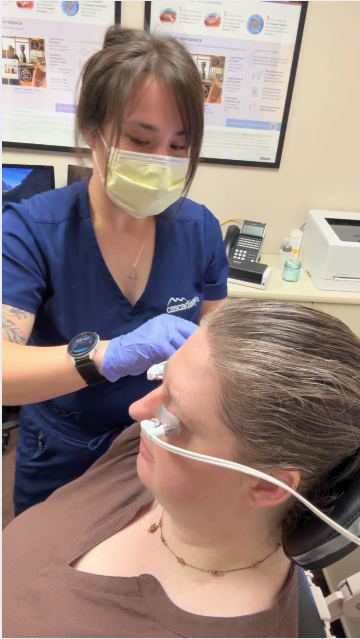
Cascadia Eye has a local comprehensive dry eye care center where you will find a full option of advanced treatment options that allow us to treat the root causes of dry eye, not just the symptoms. In addition to conventional dry eye treatments, we offer:
- Bruder Ocular Surface Analyzer (BOSA): Precise medical diagnostics rapidly capture essential eye health metrics
- Lipiflow: Gentle heat and pressure on the eyelids, plus thermal pulsation, clears blocked meibomian glands and restore natural tear function
- OptiLight: Reduces inflammation using Intense Pulsed Light (IPL) improves tear quality and kickstarts your meibomian glands
- OptiLift: Applied Radio Frequency (RF) and gentle electrical impulses (IPL) tighten and strengthen eyelids, improving weak blinking. (and smoothes the skin around the eyes!)
Bottom Line
Watery eyes don’t necessarily mean that you have too many tears. Sometimes, it means your eyes aren’t maintaining a healthy tear film. Dry eye, particularly dry eye related to meibomian gland dysfunction, is a common cause of reflex tearing. However, it isn’t the only possibility.
If watery eyes are accompanied by fluctuating or blurry vision, it’s worth finding out why. An eye examination can help determine whether the problem is related to dry eye, your prescription, blood sugar, cataracts, medications, the cornea, or another condition.
At Cascadia Eye, our doctors evaluate the health of your eyes—not just how clearly you can see—and can help determine what’s behind changes in your vision and comfort.

AI Disclosure: Portions of the research, drafting, and editing process for this article were developed with assistance from OpenAI’s ChatGPT and Anthropic’s Claude. All content was reviewed, revised as needed, and approved by the author prior to publication.
Contact Cascadia Eye
If you would like to learn more, or if you would like to schedule an appointment or consultation with our talented doctors at Cascadia Eye, please contact us today. Our entire team is committed to protecting and improving your vision and the health of your eyes. We are happy to answer any questions you might have!
In addition, join us on Facebook, Instagram or YouTube to ask your questions about eyes, exams, and our practice. We’d love to hear from you – and there might be a blog to address your questions in the future.